

Blog
PhD Diploma: Meaning, History & Custom Novelty Replicas

Key Takeaways
A PhD diploma represents the highest academic credential available in most countries, classified internationally as ISCED level 8, certifying that the holder has completed original research and successfully defended a dissertation.
PhonyDiploma.com creates high-quality novelty and replica PhD diplomas designed exclusively for decorative display, entertainment, gifts, and creative projects—never for fraudulent or official use.
Earning a real PhD typically requires 3-8 years of advanced study, including coursework, comprehensive exams, original research, dissertation writing, and a successful defense before academic examiners.
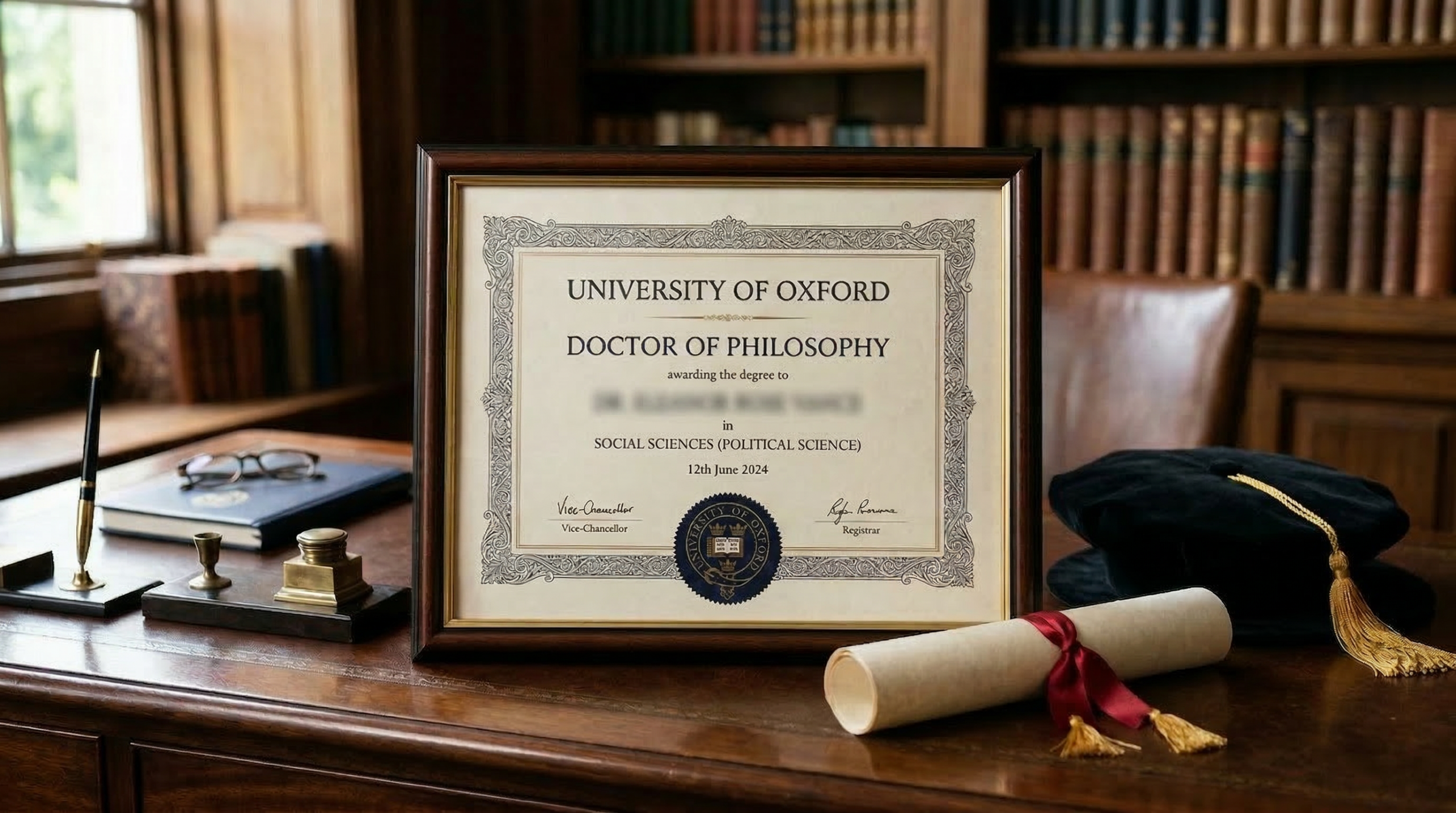
Customization options for novelty PhD diplomas include school name, field of study, graduation date, raised gold seals, embossed crests, and premium diploma-grade paper to achieve a professional aesthetic.
This article covers the full history of the doctorate degree, its modern value and criticisms, practical uses of replica diplomas, and frequently asked questions about ordering and legal considerations.
What Is a PhD Diploma?
A PhD, or Doctor of Philosophy, is a type of doctorate degree that involves advanced postgraduate study and original research in a specific field. [Fact: 1. A PhD, or Doctor of Philosophy, is a type of doctorate degree that involves advanced postgraduate study and original research in a specific field.]
A PhD diploma is the formal printed document awarded by an accredited university upon successful completion of a Doctor of Philosophy degree. This certificate confirms that the graduate has met all academic requirements, conducted original research, and defended a dissertation before a committee of experts. The diploma itself serves as legal documentation of the holder’s right to use the title “Doctor” in academic and professional contexts.
By 2026, the PhD is classified internationally as ISCED level 8—the highest level in the International Standard Classification of Education. This designation positions the doctorate degree as the terminal research credential in virtually every country. The physical diploma typically displays the institution’s name, the degree conferred (Doctor of Philosophy), the specific field of study, the graduate’s name, the conferral date, and official signatures or seals from university authorities.
PhD programs span nearly every academic discipline imaginable. Common fields include physics, history, computer science, psychology, mathematics, arts, humanities, and social sciences, mirroring the wide range of degrees and majors available for novelty diplomas. Whether someone studies molecular biology or medieval literature, the dissertation represents their contribution of new knowledge to the discipline. The diploma certifies this accomplishment.
It’s essential to distinguish between a real, accredited PhD diploma and a novelty or replica document created purely for decorative or entertainment purposes. A genuine PhD diploma grants professional standing and academic credentials. A replica diploma from providers like PhonyDiploma.com serves different functions—display, gifts, props, or commemorative items—and cannot substitute for official academic verification under any circumstances.
History of the Doctor of Philosophy Degree
Understanding the PhD’s history helps explain why the diploma carries such prestige in 2026. The credential represents centuries of academic evolution, shaped by educational reforms across Europe and North America.
The roots of doctoral education extend back to medieval European universities established around 1150, particularly in Paris and Bologna. These early institutions organized their faculties into four primary divisions: arts, theology, medicine, and law. Doctorates from this period recognized advanced learning and mastery, though they didn’t necessarily require the structured research dissertation that characterizes modern PhD programs. Candidates typically demonstrated expertise through public disputations or examinations.
The transformation into a research-focused philosophy degree occurred during 17th and 18th century reforms in German universities. These institutions gradually developed the Doctor of Philosophy as a distinct terminal teaching and research credential, setting the foundation for what we recognize as a doctoral program today.
Educational Reforms in Germany and Their Global Impact
The pivotal moment came in the early 19th century with educational reforms at institutions like the University of Berlin, founded in 1810 by Wilhelm von Humboldt. These reforms emphasized research, academic freedom (Lehrfreiheit), and the integration of original inquiry into the university’s core mission.
During this period, the arts faculty expanded dramatically to encompass natural sciences and humanities, all operating under the philosophical umbrella of “philosophy.” The German model formalized requirements including:
Original research contributions
Publication expectations
Oral defense of a dissertation
Supervised study under established scholars
These elements became the backbone of modern doctorate programs. Requirements like publishing and defending a dissertation became central to earning the Doctor of Philosophy title.
The first American PhDs, awarded by Yale University in 1861, directly copied key elements of the German research model. This transatlantic adoption launched rapid growth in doctoral education across the United States. By the early 20th century, the PhD diploma was widely recognized across Europe and North America as the standard research degree.
Evolution of the PhD in the United Kingdom and United States
UK universities initially followed a different trajectory, focusing on higher doctorates such as the Doctor of Science (DSc) and Doctor of Letters (DLitt) before introducing a modern PhD in 1917. When the British PhD was introduced, it deliberately adopted key elements from the German and emerging American systems: structured coursework, supervised research under an advisor, and a formal thesis defense.
In the United States, doctorates were exceptionally rare in the mid-1800s. The shift from rare doctorates to widespread PhD programs occurred between 1900 and 1920 at major universities including:
Johns Hopkins University
The University of Chicago
Harvard University
Columbia University
By the late 20th century, the PhD diploma became essential for tenure-track faculty positions and high-level research roles in both countries. The institutional structures supporting PhD training—graduate divisions, research centers, funding mechanisms—had solidified into the recognizable forms doctoral students encounter today.

What Does It Take to Earn a PhD (and the Diploma That Comes With It)?
The modern PhD journey spans 3-8 years of advanced study beyond a bachelor’s degree or master’s degree. This represents a substantial commitment that separates the highest degree from other academic achievements.
Admission to a doctoral program in 2026 typically requires:
Requirement | Description |
|---|---|
Prior Degree | Bachelor’s degree minimum; many programs prefer a master’s degree |
Research Proposal | Statement outlining intended research direction |
Academic References | Letters from professors or research supervisors |
Standardized Tests | GRE or discipline-specific exams (varies by program) |
Interviews | Assessment of fit between student interests and faculty expertise |
Once admitted, candidates progress through several well-defined milestones: |
Advanced Coursework: Brings all doctoral students to a common knowledge level while exposing them to current research frontiers
Comprehensive Exams: Assess mastery of the discipline and readiness for independent research
Proposal Defense: The candidate develops and defends a detailed research plan before faculty
Original Research: The bulk of time devoted to novel investigation in the specific field
Dissertation Writing: Documentation of findings (typically 100-300 pages depending on discipline)
Successful Defense: Final oral examination before a committee of experts
The PhD diploma is awarded only after examiners confirm the candidate’s original contribution to knowledge. Many PhD students hold teaching or research assistantships during their studies, providing both funding and professional training. This explains why the diploma symbolizes not just research expertise but also professional development in academic roles.
Models of PhD Supervision and Training
The relationship between a PhD student and their supervisor (or advisory committee) fundamentally shapes the research journey from proposal to completed dissertation. Supervisors guide progress, provide feedback, and troubleshoot methodological or conceptual challenges throughout the process.
Supervision approaches vary considerably:
Structured approaches: Emphasize defined milestones, skills development, and regular checkpoints
Flexible approaches: Allow negotiated timelines and student-driven exploration
Hybrid models: Combine structure with autonomy depending on project stage
By the 2020s, institutional quality codes established expectations for frequent communication, documented progress reviews, and transparent milestones. Many universities now offer formal training programs for supervisors covering pedagogy, ethical supervision practices, and handling diverse student needs.
Candidates themselves often receive structured training beyond discipline-specific coursework, including research methods seminars, ethics workshops (particularly for human subjects research), and teaching development programs. These comprehensive training elements reinforce why the PhD diploma represents genuine academic achievement across multiple competencies.
Value and Criticism of the PhD in 2026
The PhD remains both highly respected and widely debated in the 21st century. Understanding both perspectives helps contextualize what the diploma represents in today’s academic and professional landscape.
PhD holders constitute approximately 1% of adults in many OECD countries, forming a genuinely elite academic and research community. This rarity contributes to the credential’s prestige but also creates tension in labor markets where PhD supply may exceed traditional academic demand.
Benefits of holding a PhD include:
Access to tenure-track academic careers
Advanced research positions in industry (pharmaceuticals, tech, defense, energy)
Policy roles in government and international organizations
Leadership positions in nonprofit research institutions and think tanks
Consulting opportunities requiring deep expertise
However, earnings premiums for PhD holders over master’s degree holders remain modest and highly field-dependent. In computer science and engineering, the premium can be substantial. In humanities and social sciences, it’s often minimal or even negative compared to alternative credentials.
Common criticisms of PhD programs include:
Extended time to degree (7-9 years in humanities)
Mental health challenges among doctoral students
Precarious postdoctoral contracts with limited job security
Oversupply of research doctorates in certain disciplines
Mismatch between training and labor market opportunities
These debates continue shaping discussions about the sustainability and purpose of PhD education in many fields.
National and Disciplinary Variations
Degree titles vary internationally despite similar underlying requirements. While “PhD” and “Doctor of Philosophy” are globally recognized, variations exist:
Designation | Usage |
|---|---|
DPhil | Oxford University, some Australian institutions |
Dr. phil. | German-speaking countries |
EdD | Doctor of Education |
D.Eng. | Doctor of Engineering |
DBA | Business administration doctorate |
Entry requirements differ significantly across international institutions. Some countries require candidates to hold a master’s degree before entering a PhD program; others permit direct entry from an honors bachelor’s degree. The licentiate degree system, still used in some Scandinavian countries, represents an intermediate qualification affecting how doctoral credentials are positioned. | |
Funding mechanisms profoundly shape PhD access and completion: |
Government stipends: Common in Scandinavia, Germany, and some Asian countries
Competitive scholarships: Fulbright, DAAD, national research council awards
Self-funded routes: More common in UK, US (non-STEM), and Australia
STEM academic fields typically feature shorter median completion times (5-6 years) due to structured graduate programs, defined research projects, and clear milestones. Humanities and social sciences often span 7-9 years, as dissertation-based research is less standardized.
Despite these variations, the PhD diploma generally certifies completion of substantial, peer-reviewed original research across most fields.
PhD Diplomas in the Workforce and Everyday Life
By 2026, PhD diploma holders work across diverse professional sectors:
Universities (as faculty or researchers)
Government research laboratories and agencies
Pharmaceutical and biotech companies
Technology firms (especially in AI, data science, and information technology)
Financial institutions
Policy organizations and international bodies
NGOs focused on research or technical work
The diploma frequently appears displayed in offices, laboratories, clinics, consulting rooms, and home libraries as a symbol of expertise and achievement. Clients and colleagues encountering a framed PhD diploma often interpret it as evidence of advanced credibility and knowledge within the graduate’s discipline.
Many professionals face a practical dilemma: the original diploma is a treasured, irreplaceable document representing years of work, yet displaying it in daily work environments exposes it to sunlight, dust, moisture, and potential damage. Consequently, graduates commonly store the original diploma in a secure location (safe, sealed storage, or bank safety deposit box) and use a replica for everyday display.
This practice underscores the distinction between the diploma as a legal credential (kept secure) and the diploma as a symbol of achievement (displayed publicly). The psychological significance extends beyond professional purposes to personal affirmation of years of struggle and intellectual growth.

Common Non-Official Uses of Replica PhD Diplomas
Replica or novelty PhD diplomas serve several legitimate, ethical purposes distinct from fraudulent misrepresentation:
Film and Television Production Productions frequently require authentic-looking academic props to dress academic scenes, laboratories, or therapist offices. Purchasing a novelty diploma proves far more practical than obtaining unused actual diplomas or creating custom forgeries.
Gift Diplomas Milestone birthdays, retirement parties, or humorous awards (such as “Doctor of Coffee Studies” or “Doctor of Procrastination”) use novelty diplomas where the joke is transparent to all parties. These create memorable gifts with playful wording.
Professional Display Academics working in multiple offices might display a replica in a secondary location while preserving the original at home or in a primary office. This protects irreplaceable documents while maintaining professional appearance.
Creative and Social Uses Reunion displays, themed costume parties, educational role-play simulations, and social media photo shoots for creative purposes all represent contexts where replica diplomas serve legitimate functions without deception.
Critical Boundary: Replica PhD diplomas must never be misrepresented as official proof of qualifications in any formal context—employment, licensing, immigration, or academic admission.
Novelty & Replica PhD Diplomas from PhonyDiploma.com
PhonyDiploma.com specializes in high-quality novelty and replica-style PhD diplomas designed exclusively for entertainment and decorative use, alongside other authentic-looking fake doctorate degree options. These products cater to customers seeking professional-looking documents for display, gifts, props, or commemorative purposes.
Key design elements include:
Heavyweight diploma-style paper matching genuine document quality
Realistic layouts inspired by traditional academic aesthetics
Options for raised seals or embossing
Professional typography and formatting
Customizable text fields for personalization
PhonyDiploma.com does not issue real degrees or accredited credentials. The company is not affiliated with universities, educational authorities, or professional licensing bodies. Products cannot grant official academic qualifications under any circumstances.
Customers can customize text including degree title (PhD or Doctor of Philosophy), field of study, graduation date, and school’s location to create a document matching their vision. Whether for personal use, creative projects, or gift-giving, the emphasis remains on quality presentation for novelty purposes.
Legal and ethical disclaimer: Products must not be used for employment applications, professional licensing, academic admission, immigration purposes, or any form of deception.
Customization Options for Your PhD Novelty Diploma
PhonyDiploma.com offers extensive customization to create authentic-looking novelty documents, drawing on thousands of diploma, transcript, degree and certificate samples:
School Name Options
Real university names (subject to local regulations)
Fictional institution names
Generic “University” styling
Editable Elements | Field | Examples | |——-|———-| | Student Name | Full legal name or nickname | | Degree Title | Doctor of Philosophy, PhD | | Major/Field | Computer Science, Psychology, History | | Minor (optional) | Related discipline | | Date of Completion | Actual or symbolic date |
Visual Upgrades
Raised gold foil seals
Embossed crests and decorative borders
Choice of typography (traditional serif or modern)
Latin mottos and academic styling
Some packages include matching novelty transcripts, decorative diploma folders, or additional copies for multi-office displays. All artwork is created for novelty and commemorative purposes, without university signatures or official verification elements.
Ordering and Approval Process
The ordering experience follows a straightforward workflow, and customers can preview a free online sample of custom diplomas before committing to a final print:},{
Choose Template: Select PhD diploma category from available options
Submit Details: Provide customization information through the online form
Review Proof: Receive a watermarked digital proof for verification
Approve Design: Confirm spelling, dates, and layout accuracy
Production: Final printing proceeds upon approval
Delivery: Shipping via selected method
Customers can request watermarked digital proofs to check all details before final printing. This prevents errors and ensures satisfaction with the finished product.
Available Formats
Physical copy: Diploma-grade paper, professionally printed and shipped
Digital copy: High-resolution file for immediate use or personal printing
Bundle packages: Both physical and digital versions
Turnaround expectations include same-day proofs on business days, fast production once approved, and multiple shipping speeds. Customers should use special instructions fields to describe layout preferences, meaningful dates, or gift messages for staff attention.
Responsible and Legal Use of Fake PhD Diplomas
PhonyDiploma.com products are not accredited degrees and cannot function as official credentials under any circumstances.
Acceptable Uses Include:
Wall art and decorative display
Personal collections
Gag gifts with clear satirical intent
Movie and television props
Cosplay and themed costume accessories
Party decorations
Office or home commemorative displays
Prohibited Uses:
Employment applications or job interviews
Professional licensing (medicine, law, engineering, psychology)
Immigration or visa applications
Academic admission
Any context requiring educational verification
Using novelty documents to misrepresent qualifications is unethical and may be illegal in many jurisdictions. Consequences can include criminal fraud charges, civil liability, termination of employment, license revocation, and immigration penalties.
Designs intentionally avoid copying live official signatures and include marketing disclaimers encouraging responsible use, aligning with broader guidance on fake diplomas and transcripts as novelty items. Contact PhonyDiploma.com customer support with questions about appropriate use or local regulations before ordering.
Frequently Asked Questions (FAQs)
FAQs About PhD Diplomas and Novelty Replicas
Is a novelty PhD diploma from PhonyDiploma.com a real academic degree?
No. The item is purely a novelty or decorative document and does not represent an accredited PhD or any academic qualification whatsoever. Only accredited universities and authorized educational institutions can award real PhD degrees and official diplomas following completion of a doctoral program.
Readers seeking legitimate credentials should contact accredited universities or national education authorities. Earning a genuine research degree requires formal enrollment, original research, dissertation completion, and successful defense—processes that cannot be replicated through novelty document purchases.
Can I use a fake PhD diploma to apply for a job or a license?
Absolutely not. Using a novelty diploma to misrepresent your education for employment, professional licensing, visas, or admission is explicitly forbidden and potentially criminal.
Such misuse may constitute fraud with serious consequences:
Criminal prosecution
Civil lawsuits from defrauded employers
Immediate termination if discovered post-hire
Revocation of professional licenses
Immigration penalties
PhonyDiploma.com products are sold with the understanding they are exclusively for fun, display, or artistic purposes.
What information do I need to provide when ordering a custom PhD novelty diploma?
Typical required fields include:
Name to print on the diploma
Degree title (e.g., Doctor of Philosophy)
Field of study (e.g., Psychology, Computer Science, History)
Desired graduation date
City or state to display as issuing location
If the exact historical date is unknown, customers can choose meaningful ceremonial dates such as birthdays or anniversaries. Double-check all spelling and formatting during the proof stage to avoid reprints and project delays.
How realistic will my replica PhD diploma look compared to a real one?
Designs are inspired by genuine academic styles, using similar paper weight, fonts, and seal placements where appropriate. The whole breadth of traditional doctoral aesthetics—from serif typography to gold foil seals—can be incorporated.
However, to remain ethical and legal, documents are not identical copies of any specific current university diploma and omit real signatures of actual university officials. Customers seeking particular visual styles (modern, traditional, minimalist) should mention preferences in order notes for the design team.
Can I get both a digital and a physical copy of my PhD novelty diploma?
Yes. Typical options include:
Physical print only (shipped on diploma-grade paper)
Digital file only (high-resolution PDF for immediate use)
Bundle packages (both formats included)
Digital versions work well for same-day needs or screen display, while printed versions are ideal for framing and long-term preservation. Pricing and turnaround times may differ between formats, so review specific options during checkout.

Whether you need a thoughtful gift for a milestone celebration, professional-looking props for film production, or a commemorative sample to display while protecting your original degree diploma, novelty PhD diplomas serve many legitimate purposes. The key is understanding the clear distinction between decorative documents and official academic credentials.
Explore PhonyDiploma.com’s customization options to create a high-quality replica that meets your specific needs—while always using these products responsibly and ethically, and reviewing sample fake diploma designs for USA schools to see quality and style options.