

Blog
Percentage of US Population With Master’s Degree

Introduction
When discussing the percentage of the US population with a master’s degree, it is important to define the scope and time frame. This analysis focuses on adults aged 25 and older, as reported by the U.S. Census Bureau, which is the primary data source for educational attainment statistics in the United States.
Understanding the percentage of Americans with a master’s degree matters for several reasons. For job seekers, it provides insight into the competitive landscape and the value of advanced education in the labor market. Employers can use this information to inform hiring strategies and workforce development, while policymakers rely on these statistics to shape education policy and address workforce needs. This article is intended for students, educators, employers, and the general public who are interested in trends in higher education and their implications for career advancement and economic opportunity.

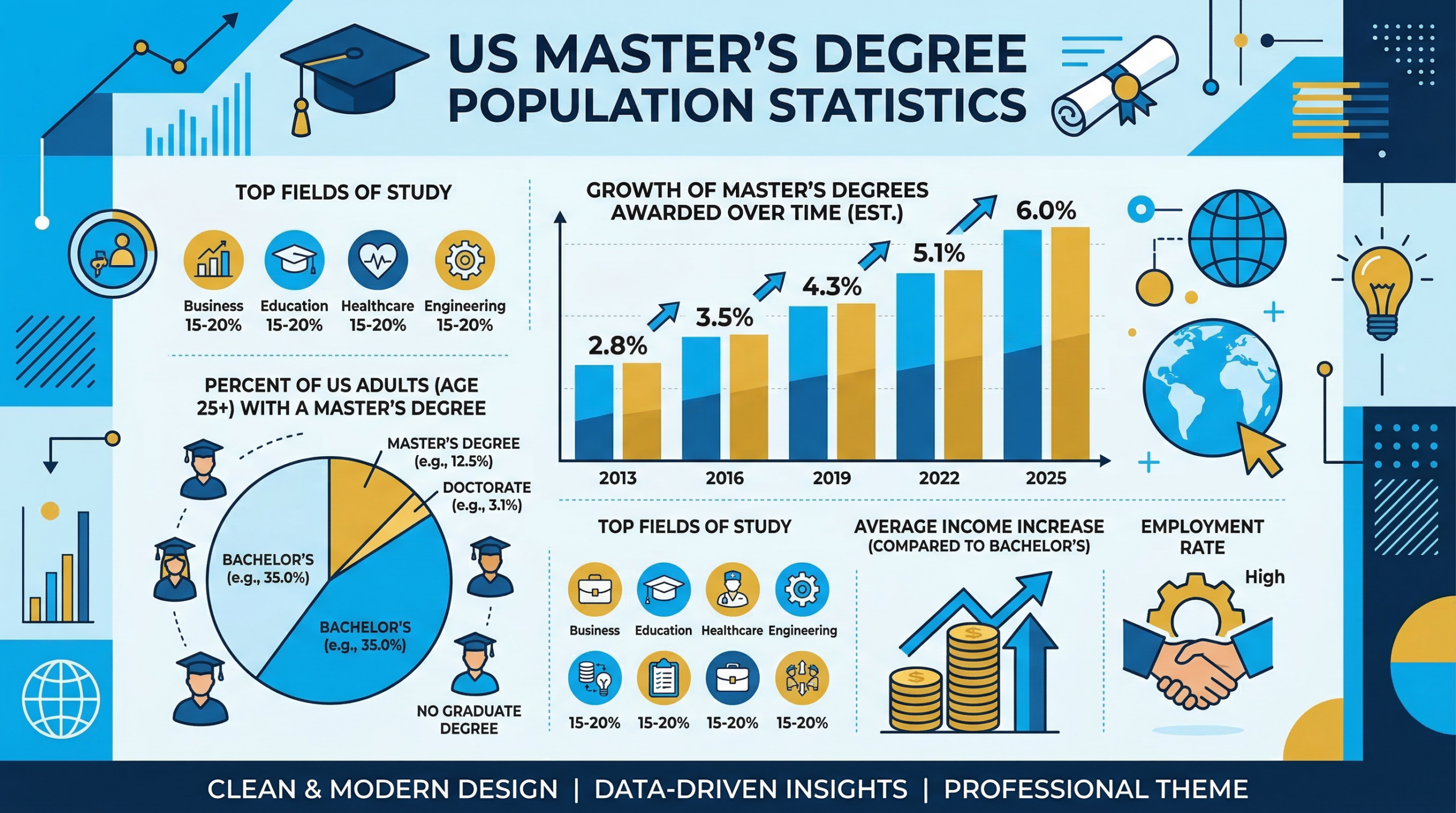
Alt text: Diverse group of college graduates celebrating with caps and gowns
Summary: Key Statistics on Master’s Degree Attainment in the US
14.4% of Americans now hold a master’s degree or higher (as of 2021, U.S. Census Bureau).
Approximately 11% to 15% of U.S. adults aged 25 and older hold a master’s degree as their highest level of education.
As of 2025, about 14% to 15% of U.S. adults aged 25 or older hold a master’s degree or higher.
An advanced degree (which includes master’s, professional, and doctoral degrees) is held by 14.4% of Americans.
Educational Attainment Overview
Definition of Educational Attainment
Educational attainment refers to the highest degree or level of school completed by an individual, whether that is a high school diploma, a GED/high school equivalency certificate, an associate’s, bachelor’s, master’s, or higher degree. This measure focuses on the highest degree obtained or the highest level of school completed, and is a key indicator of educational achievement across different demographic groups and over time.
It is important to distinguish between degree holders and current college students—educational attainment statistics only count the highest degree or school completed, not enrollment status. For example, someone currently attending college but who has not yet graduated would not be counted as having completed a bachelor’s degree.
Data Collection Methods
The U.S. Census Bureau collects and reports educational attainment data through several surveys, including the American Community Survey (ACS), the Current Population Survey (CPS), and the decennial census. These sources provide the most reliable statistics on the percentage of the U.S. population with a master’s degree and other levels of educational attainment.
According to recent data, 90% of all adults aged 25 years or older in the United States have completed at least high school or obtained a GED/high school equivalency certificate.
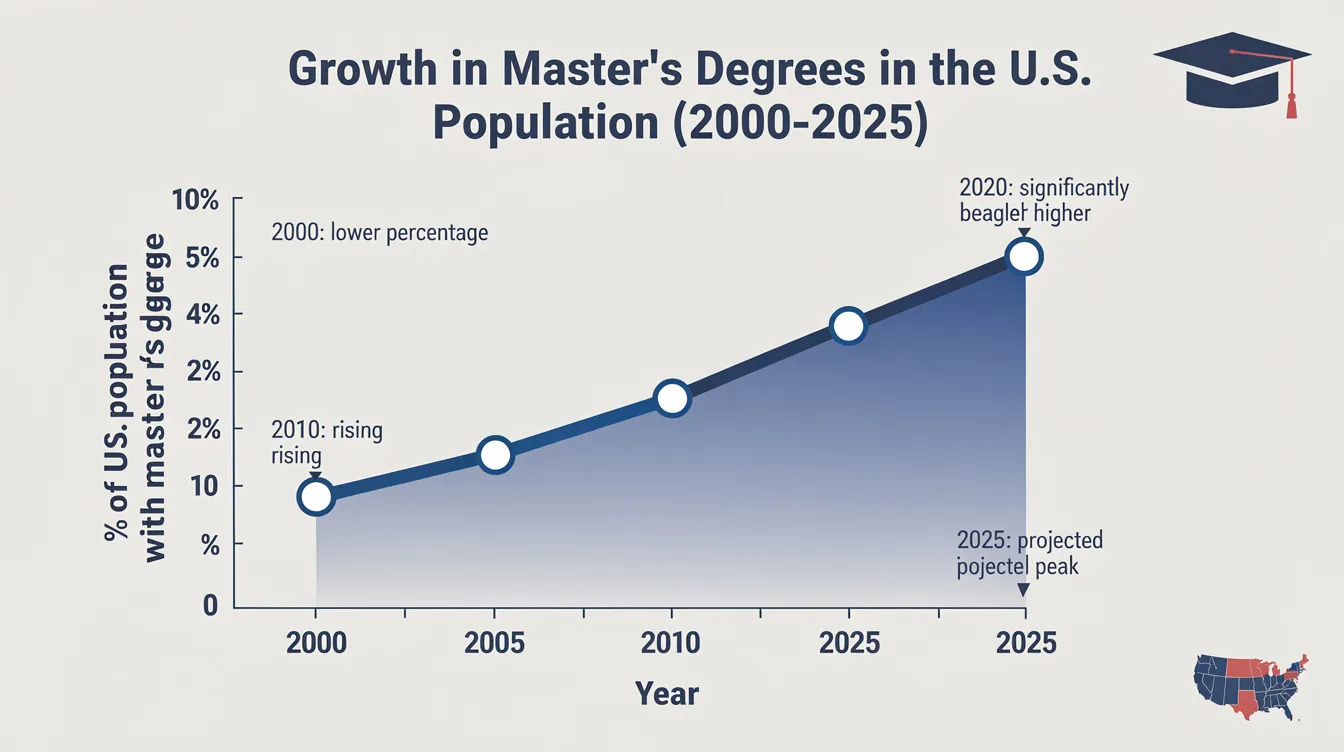
Alt text: Infographic showing growth in percentage of U.S. population with master’s degrees from 2000 to 2025
With this context in mind, we can now examine the national share of master’s and other advanced degrees.
National Share of Master’s and Other Advanced Degrees
Recent Trends and Key Statistics
As of 2021, 14.4% of Americans now hold a master’s degree or higher.
The percentage of Americans with a master’s degree has nearly doubled over the past two decades, rising from 3.86% in 2001 to 7.26% in 2021.
What Is an Advanced Degree?
An advanced degree (which includes master’s, professional, and doctoral degrees) is a postgraduate academic qualification beyond the bachelor’s level. In 2021, 14.4% of people in the U.S. have earned an advanced degree, which includes master’s, professional, and doctoral degrees.
Master’s Degree Growth: At-a-Glance
Approximately 13.1% of the U.S. population aged 25 and older holds a master’s degree.
Master’s degrees represent one of the fastest-growing segments of higher education in the United States.
The number of master’s degree holders has doubled since 2000, reaching over 21 million.
Between 2011 and 2021, the number of master’s degrees conferred annually grew by 16%.
When combined with professional and doctoral degrees, about 14.4% of U.S. adults have attained a graduate or professional degree.
The master’s degree has transformed into an advanced postgraduate academic degree, bridging the gap between undergraduate studies and doctoral research. A master’s degree is increasingly important for career advancement and specialization in today’s job market.
As we explore degree attainment further, it is helpful to compare master’s degree holders with those at other educational levels.
Bachelor’s Degrees, College Degrees, and Master’s Comparison
Bachelor’s Degree vs Master’s Degree Attainment
When comparing educational attainment in the U.S., about 37% of adults have completed education at the bachelor’s level, while approximately 14% have earned a master’s degree. The growth rate for master’s degrees has outpaced that of bachelor’s degrees in recent years, reflecting increased interest in advanced education.
Notably, individuals with a master’s degree earn a median weekly wage of approximately $1,737, which is 16% higher than those with only a bachelor’s level degree. The average income for those with a master’s degree is significantly higher, with an average income difference of roughly $21,000 compared to individuals holding only a bachelor’s degree.
College Degrees by Level
In the United States, educational attainment varies across different degree levels. Here is a breakdown of the highest degree held by adults aged 25 and older:
Associate degree: Approximately 10%
Bachelor’s degree: About 37%
Master’s degree: Roughly 11% to 15%
Doctoral degree: A smaller but notable percentage (typically 2% to 3%)
This distribution reflects the importance of two-year postsecondary programs, the dominance of bachelor’s degree holders, and the significant portion of Americans who have pursued advanced postgraduate education.
Degree Completion Rates
Each year, millions of degrees are conferred across various levels of higher education. Recent data show a steady increase in the number of bachelor’s and master’s degrees awarded annually, highlighting growing interest in advanced education. The average six-year college graduation rate for students entering in 2017 reached 63.6%, demonstrating that a majority of students complete their degrees within a reasonable timeframe.
High school completion rates have also improved over time, with the percentage of individuals graduating from high school or obtaining a GED rising from 85% in 1983 to 90% today. This increase in high school completion supports greater access to postsecondary education and contributes to the rising number of college graduates.
When comparing degrees conferred, bachelor’s degrees continue to outnumber master’s degrees, but the gap is narrowing as master’s programs grow in popularity and importance in today’s job market.
With these comparisons in mind, let’s take a closer look at the demographics of master’s degree holders.
Demographics of Master’s Degree Holders
Gender and College Graduates
Female students have consistently earned a higher share of master’s degrees compared to their male counterparts.
In the 2021–22 academic year, women earned 63% of all master’s degrees conferred.
This trend has been consistent over recent years, with women earning:
62% of master’s degrees in 2020-21
59% in 2015/2016
A projected 62.9% in 2015/2016
The gender gap is also evident across other degree types, including associate’s and doctoral degrees.
The educational attainment of women has now surpassed that of men in terms of completion of both secondary and post-secondary education.
These trends highlight the ongoing shift in higher education, with female students leading in degree completion rates and narrowing the gender gap across all levels of academic achievement.
Master’s Degree Attainment by Race and Ethnicity
When examining the percentage of the US population with a master’s degree, there are significant disparities among different racial and ethnic groups:
Among Asian Americans, nearly half (49.8%) had a four-year college degree, and Asian students consistently show higher graduation rates compared to other groups.
Only 11.4% of the Hispanic population (including both native and foreign born Hispanics) had a four-year college degree, highlighting a notable gap in educational attainment.
The educational attainment of African American adults remains lower than that of non-Hispanic whites, reflecting ongoing disparities.
Differences are also evident when comparing the native born population to foreign-born individuals, with native-born Americans generally achieving higher levels of education.
In many households, comparing the educational levels of three adults can reveal these broader societal trends, as differences in attainment often reflect the demographic and socioeconomic factors at play.
Master’s Degree Attainment by Age Cohort
Adults aged 35 to 44 are the most likely to hold a postsecondary credential, with 53.2% in this group having completed some form of higher education.
This age cohort surpasses both younger and older groups in terms of degree completion, reflecting trends in access to education and changing societal expectations over time.
Geographic Variation Among College Graduates
States with the highest percentage of residents holding a master’s degree or higher include Massachusetts, Maryland, and Connecticut.
These states consistently rank at the top, with Massachusetts often cited as having the highest percentage of master’s degree holders in the nation.
In contrast, states such as West Virginia and Mississippi have among the lowest percentages of residents with a master’s degree or higher.
This regional variation highlights the differences in educational attainment across the country.
With a clearer picture of who holds master’s degrees, let’s explore the fields of study and occupational outcomes for these graduates.
Fields of Study and Occupational Outcomes
Distribution by Field
When examining the percentage of the US population with a master’s degree, it’s important to consider the distribution of degrees across various fields. The distribution of master’s degrees in the U.S. has shifted significantly in recent years, with business and health-related fields steadily growing, mirroring the wide variety of degrees and majors available across modern higher education.
Growth in STEM and Business
Business is now the most common field for master’s degree attainment, making up 23.4% of graduates.
Health professions have also seen substantial growth, reflecting the increasing demand for medical specialists, counselors, and therapists.
Natural sciences, including disciplines such as biology, chemistry, and physics, have experienced notable expansion as part of the broader STEM (Science, Technology, Engineering, and Mathematics) sector.
The largest surge in master’s degrees has occurred in Computer and Information Sciences, which saw a 145% increase between 2011 and 2022.
Social sciences have seen a relative decline in degree awards as more students pursue applied and professional fields.
Earnings by Field
Master’s degrees span a vast array of disciplines and specializations, catering to specific academic and professional aspirations. Related programs—such as interdisciplinary studies and emerging fields—are also increasingly popular, reflecting evolving industry demands and educational pathways. Overall, master’s degree holders enjoy a significant earnings premium compared to those with only a bachelor’s degree, especially in high-demand fields like business, health professions, and natural sciences.
Alt text: Person holding a master’s degree diploma in a professional office environment
As we consider the value of a master’s degree, it’s important to understand how it fits within the broader context of advanced degrees and how fake diploma samples in the USA differ from legitimate academic credentials.
Doctoral Degrees and Other Advanced Degree Context
When comparing advanced degrees in the U.S., it’s important to distinguish between master’s degrees, doctoral degrees, and professional degrees. Doctoral and professional degrees represent the highest levels of academic achievement, with doctoral degrees (such as Ph.D.) focusing on research and academic scholarship, while professional degrees (like M.D. or J.D.) are oriented toward specific professions.
In 2021, 14.4% of people in the U.S. have earned an advanced degree (which includes master’s, professional, and doctoral degrees). While master’s degrees remain the most common type of advanced degree, the number of individuals earning doctoral and professional degrees has steadily increased over time, reflecting their growing significance in the labor market and the evolving landscape of postgraduate qualifications.
Additionally, trends show a rising number of women attaining doctoral degrees, contributing to shifts in gender distribution among holders of advanced degrees.
Understanding the relationship between educational attainment and social class can further illuminate the impact of advanced degrees.
Educational Attainment and Social Class
In the United States, educational attainment is one of the most significant indicators of social class. While the American class system is complex and often debated, higher education—especially advanced education such as graduate degrees—remains a key marker of status and opportunity. Achieving a master’s degree or other graduate degrees is not only a symbol of academic achievement but also a primary gateway to professional occupations and the professional middle class.
Individuals with higher educational attainment, particularly those who have completed 7-8 years of postsecondary education, are more likely to enter professions that offer greater job security, higher incomes, and increased social prestige. These advanced qualifications are often required for entry into fields such as law, medicine, academia, and business administration. As a result, educational attainment serves as the main barrier to accessing privileged middle-class status and the economic benefits that come with it.
However, the landscape of the middle class is changing. The statistical middle class—defined as households earning 80% to 120% of the national median income—may struggle to maintain a traditional middle-class lifestyle, as income inequality widens and the cost of living rises. In contrast, members of the professional middle class, who typically hold graduate degrees or higher education credentials, tend to enjoy greater economic security and resilience, even during economic downturns. Still, advanced education does not guarantee immunity from job insecurity; for example, many college faculty members now work part-time or on short-term contracts, reflecting broader shifts in the labor market.
Ultimately, educational attainment remains a powerful determinant of social class and economic opportunity in the US. Advanced education and graduate degrees continue to open doors to professional careers and upward mobility, even as the definition and stability of the middle class evolve.
To ensure the accuracy of these insights, let’s review the data sources and methodology behind these statistics.
Data Sources, Methodology, and Caveats
The educational attainment statistics presented in this article are primarily sourced from the U.S. Census Bureau’s American Community Survey (ACS) and the Current Population Survey (CPS). These surveys are the most comprehensive and reliable sources for tracking education levels across the United States. They collect data on the highest degree or level of school completed by individuals, providing detailed insights into the educational landscape.
This analysis focuses on adults aged 25 years and older, as this age cutoff is commonly used to ensure that most individuals have had the opportunity to complete their formal education. Including younger age groups could skew the data since many are still pursuing their education.
It is important to note that all survey data are subject to sampling error and annual variations. Year-to-year changes in educational attainment percentages may reflect these sampling fluctuations as well as real demographic shifts. Therefore, trends should be interpreted over multiple years rather than relying on single-year data points.
Additionally, educational attainment data represent the highest degree completed and do not account for current enrollment status. For example, individuals currently attending college but without a completed degree are not counted as degree holders. This distinction ensures clarity in understanding the true educational achievement levels within the population.
With a solid understanding of the data, let’s consider what these trends mean for students and employers.
Relevance to College Students and Employers
When interpreting trends in the percentage of the US population with a master’s degree, employers should recognize that the rising demand for skilled workers indicates that job markets are able to accommodate an increasing number of highly qualified individuals, offering them improved employment opportunities. The master’s degree has become a pivotal factor in career advancement and specialization in the contemporary professional landscape. For many organizations, candidates with advanced formal education are increasingly valued for their expertise and ability to contribute to specialized roles.
For college students considering their next steps after completing their college education, it is important to understand the value of formal education in today’s workforce. Obtaining a master’s degree can open doors to higher-level positions and research opportunities, making it a strategic choice for those seeking to enhance their professional credentials. The importance of a master’s degree is underscored by its potential to boost career prospects and earning potential without the commitment of a doctoral program.

Alt text: Students attending a master’s degree level course in a university lecture hall
As the value of advanced education grows, it’s important to be aware of the distinction between legitimate and novelty credentials.
Novelty Diplomas, Replica Degrees, and Legal Notes (PhonyDiploma.com)
PhonyDiploma.com specializes in providing high-quality novelty diplomas and replica degrees designed purely for decorative and entertainment purposes. These products are crafted with attention to detail, featuring realistic elements like raised seals, watermarks, and premium paper to closely mimic authentic educational documents, reflecting their reputation for phony diplomas that look real.
It is important to note that all novelty diplomas and certificates offered by PhonyDiploma.com are strictly for personal use, such as gifts, wall displays, social media props, or reunion memorabilia. They are not valid academic credentials and cannot be used for any official or fraudulent purposes, even though they may include realistic touches such as gold foil state seals and emblems.
PhonyDiploma.com includes clear legal disclaimers with every order to emphasize that these products are not real degrees and should never be used to misrepresent qualifications. Customers are encouraged to use these items responsibly, appreciating their value as unique and fun keepsakes rather than legitimate academic records, and can even request a free sample for custom diplomas to review design quality before ordering.
Whether you want a custom high school diploma replica, a college degree for a gift, or a humorous certificate for a special occasion, PhonyDiploma.com offers a wide range of diploma, transcript, degree and certificate samples to suit your needs with fast and secure online ordering.
Looking ahead, let’s explore how educational attainment is expected to evolve in the coming years.
The Future of Educational Attainment
Looking ahead, the future of educational attainment in the United States will be shaped by a dynamic mix of demographic trends, technological innovation, and evolving labor market needs. As the population grows more diverse, educational systems will need to adapt to serve a wider range of demographic groups, including both native born and foreign born populations. This shift is already evident in educational attainment data, which shows that nearly half of adults ages 25-34 now hold a bachelor’s degree or higher—a significant increase compared to older generations.
Technological advancements are also transforming how education is delivered, with online and blended learning models becoming increasingly common across postsecondary institutions. These changes are making higher education more accessible to a broader segment of the population, potentially increasing the number of college graduates and those earning advanced degrees.
Labor market projections underscore the growing demand for workers with advanced education, particularly in research-intensive fields such as science, technology, engineering, and mathematics (STEM). According to the Current Population Survey, the number of bachelor’s degrees conferred is expected to rise by 15% between 2020 and 2030, while master’s degrees conferred are projected to grow by 20%. Doctoral degrees are also expected to see a 10% increase. These trends highlight the importance of advanced qualifications for success in today’s job market.
Educational attainment data from the Census Bureau and other sources will continue to play a crucial role in tracking these developments and informing policy decisions. As the highest level of education achieved by Americans continues to rise, especially among younger adults, the US workforce will become increasingly skilled and adaptable. However, ensuring equitable access to higher education for all demographic groups will remain a key challenge for policymakers and educators alike.
In summary, the future of educational attainment in the US points toward continued growth in college degrees and advanced education, driven by demographic change, technological progress, and labor market demands. Staying informed with up-to-date educational attainment data will be essential for understanding and responding to these ongoing shifts.
Conclusion and Key Takeaways
The percentage of the US population holding a master’s degree continues to grow, reflecting the increasing importance of advanced education in today’s job market. Staying informed with the latest educational attainment statistics is essential as these figures evolve with new Census data releases.
If you’re looking for high-quality novelty diplomas, replica degrees, or custom certificates for gifts, decorations, or entertainment purposes, PhonyDiploma.com offers premium products with authentic design features like raised seals and watermarks. Explore our extensive catalog and order your custom diploma package today to add a touch of fun and sophistication to your collection!